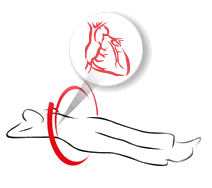
Heart scans, which use either electron beam tomography or ultrafast
Cat Scan tomography, identify calcium deposits in the coronary arteries;
the presences of calcium implies that the fat deposits
have been present for some time and is invariably associated with arteriosclerosis.
It is important to note, however, that a separate study has shown
that calcium was NOT detected in 19% of patients who suffered MACE (Am
J Cardio. 1998: 81:272-275).
In a recent prospective study, researchers enrolled over a 1000 asymptomatic,
non-diabetic adults (mean age 69; 85% white) with at least one risk factor
for heart attack and followed them for 76 months. At baseline,
a Framingham risk score was calculated (we have these in the office in
tabulated form; if we haven’t done one with you, you probably don’t
have the major risk factor of high LDL cholesterol.)
Click on this
link to calculate your Framingham risk.
Calcium scores were determined
for each subject in the trial. Among those with a 10% or greater
10 year predicted risk, calcium scores significantly contributed to the
prediction of MACE.
For example, within an intermediate-risk
group (Framingham scores of 10%-15%), the proportion of patients
with cardiac events ranged from 2.5% among patients with calcium scores
of zero (2 events in 79 patients) to 19.5% among patients with calcium
scores higher than 300 (8 events in 41 patients.)(JAMA 2004 Jan 14;291:210-5.)
There remain controversies and dilemmas associated with use of
heart scans. For example, by age 80, virtually everyone
has calcium deposits in their coronary arteries. Should we treat
everyone over age 80? Do
frequent heart scans improve patients outcomes?
It is
clear that heart scan-based calcium scores contribute very little
predictive information for patients with very low or very high
Framingham scores.
It is expected that upon the release of the American Heart Association
Scientific Statement, insurance coverage will improve for heart scans. However,
it is important to keep in mind that there is no
perfect test to predict who is in immanent danger of MACE. High
risk patients should not use this test as an excuse
to ignore and leave untreated important risk factors such as high LDL,
high blood pressure, obesity or smoking.
Another concern involves radiation
exposure. There
are two heart scan technologies out there: electron beam and ultrafast
CT. Electron beam delivers less radiation.
For women, the
major radiosensitive organ in the field of a heart scan is breast.
We
really don’t know if low dose radiation causes breast cancer or
not. All we can do is extrapolate down from atomic bomb data. No
matter how you look at it, having a heart scan is low risk (especially
electron beam). The procedure with the most radiation, a Siemens
scan, is equivalent to approximately six mammograms. If heart
scans are done infrequently, this dose poses a very low
risk.
Although we are recommending heart scans in the setting of intermediate
risk patients, anyone can have one done. We are referring to Front
Range Preventative Imaging. Call your insurance to
see if the test is covered, and under what circumstances.
|