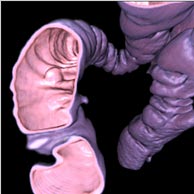
In about 20% of virtual
colonoscopies, a subsequent conventional colonoscopy is required either
because a polyp or what may be a polyp is detected.
People who
require a conventional colonoscopy as follow up will incur additional
costs, and will likely have to do another bowel prep when they do their
colonoscopy. There is no radiation associated with optical colonoscopies.
For conventional colonoscopy
a "wet prep", in which a patient drinks a large jug of "go-lytely"
the night before, is required. This procedure also involves sedation
and monitoring, time off from work and a second person to drive the patient
home after the procedure.
For virtual colonoscopy, a
dry prep, i.e. clear liquid diet for 24 hours, stool softeners, and
a cathartic are required. Patients can drive themselves home
and return to normal activities, including work, immediately.
In the Boulder area, Front
Range Preventive Imaging and Boulder
Community Hospital are performing virtual colonoscopies. At
this time, I continue to recommend the conventional test. Certainly,
for those who would otherwise not do anything, or for whom sedation
poses a health threat, etc, virtual colonoscopy is a reasonable alternative.
|